
Self-Compassion: Why Kindness Beats Self-Criticism

Self-compassion is the practice of relating to your own suffering with kindness, a sense of common humanity, and mindful awareness — rather than harsh judgment or avoidance. The model, developed by psychologist Kristin Neff, has three core elements: self-kindness, common humanity, and mindfulness. Research consistently links it to lower depression, anxiety, and shame, and to higher resilience and personal accountability.
Most people would never speak to a friend the way they speak to themselves after a mistake. Yet many believe that being hard on themselves is what keeps them responsible, motivated, and improving. The research tells a different story: self-compassion consistently outperforms self-criticism when it comes to emotional wellbeing, resilience, and even personal accountability.
What Is Self-Compassion?
In clinical psychology, self-compassion is not just “being nice to yourself.” It is a way of relating to your own suffering with kindness, a sense of common humanity, and mindful awareness instead of harsh judgment or avoidance. Kristin Neff’s influential model describes three core elements:
- Self-kindness — treating yourself with warmth and understanding rather than criticism when you struggle or fail.
- Common humanity — seeing your struggles as part of being human, not as evidence that something is uniquely wrong with you.
- Mindfulness — holding difficult thoughts and feelings in balanced awareness, without suppressing them or being swept away by them.
Self-compassion is different from self-pity, which narrows focus onto “my” suffering, and from self-indulgence, which often ignores long-term wellbeing. Instead, it aims for a caring, responsible stance toward yourself—similar to how a good friend or therapist would respond: recognising pain, validating it, and then asking what would genuinely help.
Why Does Self-Criticism Feel Useful but Usually Backfire?
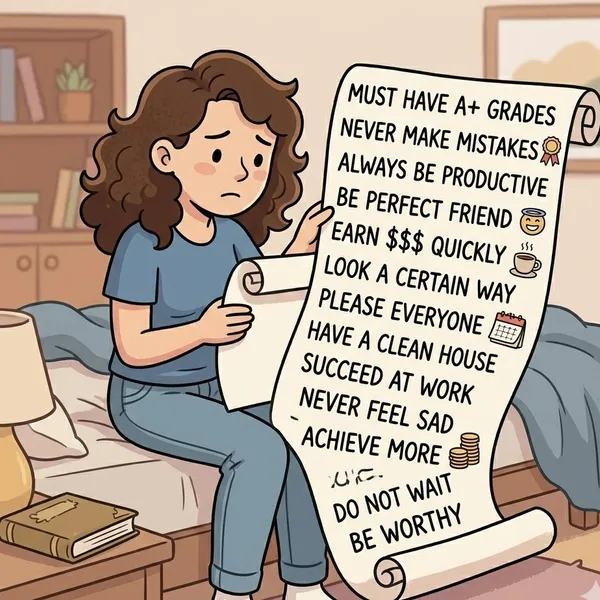
Many people are wary of self-compassion because they believe self-criticism keeps them motivated, responsible, and protected from failure. Common fears include: “If I’m not hard on myself, I’ll become lazy,” or “If I let myself off the hook, I’ll stop improving.” On the surface, these beliefs make sense: criticism can sometimes produce short-term performance boosts, especially in highly perfectionistic environments.
However, persistent self-criticism is strongly associated with higher levels of depression, anxiety, shame, and disordered eating, and with difficulties in emotion regulation and interpersonal functioning. Neurobiologically, harsh self-judgment tends to trigger threat responses—activating systems related to fear and self-protection—rather than the soothing, affiliative systems that support learning and resilience. Over time, this can lock people into cycles where each perceived failure confirms a negative self-view, making it harder to recover and try again.
How Does Self-Compassion Support Emotional Wellbeing?
Self-compassion has been linked in numerous studies to better psychological outcomes, including lower levels of depression, anxiety, stress, and shame, and higher levels of life satisfaction, resilience, and overall wellbeing. Meta-analytic work and longitudinal studies suggest that self-compassion is not just correlated with wellbeing but may buffer the impact of stress and negative events over time.
Several mechanisms have been proposed:
- Emotion regulation. Self-compassionate responses reduce secondary emotional reactions such as shame and self-hate, which can otherwise amplify distress and prolong recovery from setbacks.
- Reduced rumination. Treating mistakes and painful experiences with kindness and perspective-taking appears to reduce repetitive negative thinking and self-focused rumination.
- Greater psychological flexibility. Self-compassion is associated with more adaptive coping strategies (such as problem-solving, seeking support, and acceptance) and fewer avoidant or self-punitive strategies.
- Protection against perfectionism, conditional self-worth, and imposter feelings. Self-compassion seems to weaken the link between perfectionistic concerns, conditional self-esteem, or chronic self-doubt and poor emotional wellbeing, acting as a kind of buffer when standards are not met or when success itself feels precarious.
Importantly, self-compassion in research is consistently linked with higher, not lower, intrinsic motivation and personal responsibility, particularly when combined with clear values and realistic goals. In a meta-analysis pooling 79 studies, Zessin, Dickhäuser, and Garbade (2015) found a strong positive association between self-compassion and well-being (overall r ≈ 0.47) — making self-compassion one of the more robust psychological predictors of flourishing currently documented.
How Is Self-Compassion Different From Self-Esteem?
Self-compassion and self-esteem both relate to how we value ourselves, but they operate differently. Traditional self-esteem often depends on comparisons (being “better than average” or meeting certain standards), and can be unstable when based on external conditions such as achievements or others’ approval. In contrast, self-compassion is available even when you fail, feel inadequate, or fall short of your ideals; it does not require you to see yourself as special or above average.
Neff and colleagues have argued that self-compassion offers a more stable and less defensive foundation for emotional wellbeing than self-esteem, because it does not rely on keeping up a positive self-image at all costs. For example, people high in self-compassion tend to take more responsibility for their actions after making mistakes and are more willing to apologise or repair, precisely because recognising imperfection does not threaten their basic worth.
What Does Self-Compassion Look Like in Practice?
In everyday life, self-compassion is less about specific techniques and more about a consistent stance toward your own pain. Still, several practices have been studied and used clinically:
- Self-compassionate language. Noticing the tone of your inner voice when you make a mistake and intentionally shifting it toward how you might speak to a friend in the same situation.
- Mindful awareness of suffering. Acknowledging difficult emotions (“This is really painful right now”) instead of immediately suppressing or distracting, while avoiding over-identification or catastrophising.
- Common-humanity framing. Reminding yourself that struggle, imperfection, and vulnerability are part of being human, not personal defects (“Others feel this too; I’m not alone in this experience”).
- Self-compassion exercises and meditations. Structured practices such as compassionate imagery, loving-kindness practices, or written exercises developed in Compassion-Focused Therapy and Mindful Self-Compassion programmes.
Over time, these approaches can help shift global self-relating from hostile or punitive to more caring and balanced, which in turn supports engagement with therapy, health behaviours, and relationships.
Why Can Self-Compassion Feel Difficult at First?
For many people, especially those with histories of trauma, neglect, or highly critical environments, self-compassion can feel unfamiliar or even threatening at first. A kinder inner voice may initially trigger discomfort, disbelief, or fear of “letting your guard down.” Therapists often normalise this reaction and frame self-compassion as a skill that can be built gradually, with attention to safety and pacing.
It is also important to distinguish self-compassion from bypassing or excusing harm. Being compassionate with yourself after a mistake includes acknowledging the impact of your actions, taking responsibility, and moving toward repair—not pretending nothing happened. The shift is from “I am a terrible person and beyond hope” to “I did something that doesn’t fit my values; I can learn from this and try to act differently.” For many, that shift is what makes real change sustainable. Understanding how core beliefs are formed can also help make sense of why harsh self-talk became the default in the first place.
If self-criticism feels overwhelming, persistent, or closely linked with significant anxiety, depression, or difficulties in relationships, it may be helpful to seek support from a licensed mental wellbeing professional in your region for a personalised assessment.
Key Takeaways
- Self-compassion involves self-kindness, common humanity, and mindfulness—not self-pity or self-indulgence.
- Self-criticism triggers threat responses that lock people into shame cycles, while self-compassion activates soothing systems that support learning and resilience.
- Research consistently links self-compassion with lower depression, anxiety, and shame, and with higher motivation and personal responsibility.
- Unlike self-esteem, self-compassion does not depend on being “better than average”—it is available even in moments of failure.
- Self-compassion can feel unfamiliar at first, especially after years of self-criticism, but it is a skill that can be built gradually.
References
-
Gilbert, P. (2010). Compassion focused therapy: Distinctive features. Routledge.
-
Neff, K. D. (2003). Self-compassion: An alternative conceptualization of a healthy attitude toward oneself. Self and Identity, 2(2), 85–101.
-
Neff, K. D. (n.d.). What is self-compassion? Center for Mindful Self-Compassion. https://self-compassion.org/what-is-self-compassion/
-
Neff, K. D., & Germer, C. K. (2013). A pilot study and randomized controlled trial of the Mindful Self-Compassion program. Journal of Clinical Psychology, 69(1), 28–44.
-
Neff, K. D., & Vonk, R. (2009). Self-compassion versus global self-esteem: Two different ways of relating to oneself. Journal of Personality, 77(1), 23–50.
-
Zessin, U., Dickhäuser, O., & Garbade, S. (2015). The relationship between self-compassion and well-being: A meta-analysis. Applied Psychology: Health and Well-Being, 7(3), 340–364.
-
Dev, V., Fernando, A. T., Consedine, N. S., & Pike, A. (2022). The benefits of self-compassion in mental health professionals: A systematic review of empirical research. Healthcare, 10(19), 1926.
-
Therapy Group of DC. (2024, November 13). Why self-compassion is essential for mental health. https://therapygroupdc.com/therapist-dc-blog/why-self-compassion-is-essential-for-mental-health/
You might also like