
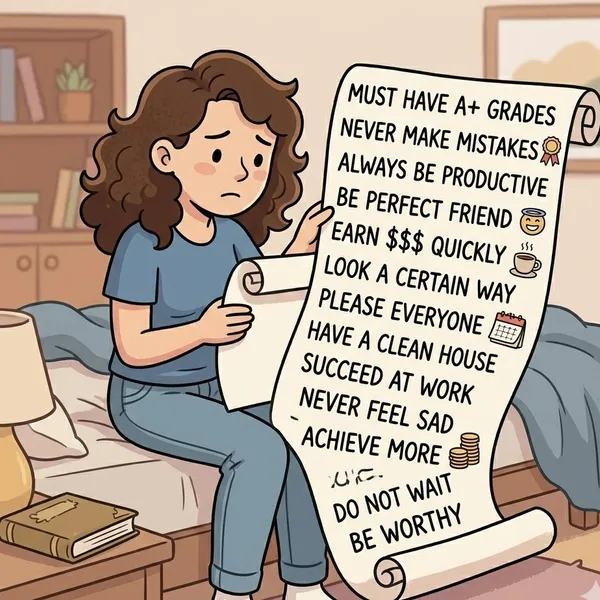
Conditional Self-Worth: When Value Feels on Trial

Conditional self-worth is the deep, often unspoken belief that your value as a person depends on meeting certain standards or earning certain kinds of approval — usually achievement, appearance, being chosen, or staying acceptable. In research, it is often called contingent self-esteem: a sense of worth that rises and falls with performance, leaving you exhausted from constantly proving you are enough.
Most people would not say out loud, “I only matter when I’m succeeding.” Yet many live as though that were true — working harder after every mistake, spiralling after criticism, or feeling fundamentally “less than” during any quiet, unproductive season. This is the everyday shape of conditional self-worth.
What Is Conditional Self-Worth?
Conditional self-worth means your sense of value depends on meeting certain standards or getting specific kinds of approval. Instead of “I matter because I exist,” the internal rule becomes “I matter when I achieve, please, or look a certain way.” In research, this is often called contingent self-esteem—a form of self-esteem that rises and falls depending on performance, appearance, or others’ reactions.
This way of relating to yourself usually starts early. When care, attention, or praise felt tied to good grades, being “easy to handle,” or looking a particular way, the nervous system can learn that safety and love are earned, not given. Over time, that learning solidifies into a lens: “If I don’t meet the condition, I’m not worthy.”
What Are the Most Common Conditions People Tie Their Worth To?
People can base their worth on many different domains. Some of the most common include:
- Achievement-based worth — “I’m only okay when I’m succeeding, productive, or ahead.”
- Appearance-based worth — “I’m acceptable when I look a certain way or get specific body-related approval.”
- Relationship-based worth — “I’m worthy when I’m chosen, wanted, or in a relationship.”
- Approval-based worth — “I’m okay when people like me and no one is disappointed or upset with me.”
On the surface, these can look like “high standards” or ambition. Underneath, they often come with a constant background fear: the sense that one mistake, one rejection, or one slower season could expose you as fundamentally “not enough.” When this fear shows up at work, it can look a lot like the imposter phenomenon.
Why Does Conditional Self-Worth Feel So Exhausting?
When your worth feels conditional, almost every situation becomes a test you can pass or fail. Research on contingent self-esteem shows that when people’s value depends on success in a specific domain, successes bring short-lived boosts, but setbacks in that domain lead to sharp drops in mood and self-esteem.
This creates a cycle:
- Do well → temporary relief. You feel safe and “enough” for a while.
- Hit a setback or receive criticism → shame spike. Mood drops, self-talk becomes harsh — sometimes in ways that match the patterns of internalized shame, where one mistake feels like proof that “I am bad” rather than “I did something I regret.”
- Scramble to restore worth. Overworking, people-pleasing, perfectionism, or withdrawing.
- Short-lived stability → new trigger. The next challenge restarts the loop.
Over time, this fragile, performance-based self-esteem is linked with higher levels of negative affect, neuroticism, and vulnerability to depressive symptoms, especially when life throws stressors in the very area your worth is tied to. Crocker and Park (2004) describe this pattern as the “costly pursuit of self-esteem” — short-term boosts when contingencies are met, but long-term costs to learning, relationships, autonomy, and physical wellbeing.
Where Does Conditional Self-Worth Come From?
Several psychological theories help explain how this pattern develops:
Conditions of worth (humanistic psychology). Carl Rogers described how children internalise “conditions of worth” when love and acceptance seem dependent on behaving in certain ways or achieving specific things. A child praised only when they excel may grow into an adult who feels worthless when they are simply average.
Attachment and early relationships. In environments where approval or emotional availability was inconsistent or tied to performance, children learn that connection is fragile and must be continually earned. This can shape internal working models like “I am only lovable when I’m useful, pleasing, or impressive.”
Social comparison and culture. Modern cultures that strongly emphasise success, productivity, and appearance intensify this tendency. Social comparison processes—constantly evaluating yourself against others—can make any pause in achievement feel like failure.
None of this is about blame. Conditional self-worth is often an adaptation: a way you learned to stay as safe and connected as possible in the environments available to you. These early experiences often solidify into what therapists call core beliefs — deep, automatic assumptions about who you are and what you deserve.
What Does Unconditional Self-Acceptance Actually Mean?
Unconditional self-acceptance does not mean telling yourself you are perfect or refusing to see your impact on others. In cognitive–behavioural traditions, it means separating your worth as a person from your performance in any single role or moment. You can acknowledge mistakes, work on growth, and accept responsibility—while still holding the belief “my value as a human is not up for negotiation.”
Research suggests that unconditional self-acceptance, self-compassion, and mindfulness are associated with lower symptom levels and may buffer against the impact of negative beliefs and emotional schemas. In other words, when your baseline stance toward yourself is kinder and less conditional, life’s inevitable setbacks are less likely to collapse your sense of who you are.
What Are Some Small Steps Toward Less Conditional Self-Worth?
Shifting from conditional to more stable self-worth is a gradual process. A few starting points often used in therapy include:
- Noticing your “if…then” rules. For example: “If I gain weight, then I’m unlovable,” or “If I’m not productive, then I’m a failure.” Simply naming these as rules rather than facts creates a little distance.
- Expanding your identity. Gently listing aspects of yourself that are not performance-based: your values, how you show kindness, your capacity for humour or creativity.
- Practising self-compassion language. Speaking to yourself as you would to a close friend who made the same mistake, especially after perceived failures.
- Reality-checking standards. Asking: “Would I apply this same standard to someone I care about?” If not, the rule may be more about fear than fairness.
- Supportive relationships and therapy. Experiencing more consistent, non-conditional acceptance in safe relationships—including with a therapist—can slowly update deep beliefs about worth.
If conditional self-worth feels intense, persistent, or linked with significant anxiety, depression, or self-harm, it may be helpful to seek support from a licensed mental wellbeing professional in your region for a personalised assessment.
Key Takeaways
- Conditional self-worth ties your value to achievement, appearance, approval, or relationships—turning everyday life into a series of pass/fail tests.
- It usually develops early, when love and safety felt connected to meeting certain standards.
- The exhausting cycle of temporary relief after success and sharp shame after setbacks keeps the pattern in place.
- Unconditional self-acceptance means separating your human worth from your performance, not ignoring mistakes.
- Small, consistent steps—naming internal rules, expanding your identity, practising self-compassion—can gradually build a more stable sense of value.
References
-
Crocker, J., & Park, L. E. (2004). The costly pursuit of self-esteem. Psychological Bulletin, 130(3), 392–414.
-
Freudly. (2026, February 25). Conditional love: How it affects self-worth and relationships. https://freudly.ai/blog/conditional-love-self-worth-relationships/
-
Kemal Arıkan, K. (n.d.). The relationship of self-esteem to conditional self-worth. https://www.kemalarikan.com/
-
Rogers, C. R. (1959). A theory of therapy, personality, and interpersonal relationships, as developed in the client-centered framework. In S. Koch (Ed.), Psychology: A study of a science (Vol. 3, pp. 184–256). McGraw–Hill.
-
Sanchez, D. T., & Crocker, J. (2005). How investment in gender ideals affects well-being: The role of external contingencies of self-worth. Psychology of Women Quarterly, 29(1), 63–77.
-
Spivey Consulting. (n.d.). Conditional vs. unconditional self-esteem & how it significantly impacts your life. https://www.spiveyconsulting.com/blog-post/conditional-vs-unconditional-self-esteem
-
Trindade, I. A., Mendes, A. L., & Ferreira, C. (2020). Relationships between emotional schemas, mindfulness, self-compassion, unconditional self-acceptance, and psychological needs. Research in Psychotherapy: Psychopathology, Process and Outcome, 23(3), 442.
You might also like