Fawn Response: When People Pleasing Is Survival

The fawn response is a trauma survival strategy in which a person seeks safety by appeasing, accommodating, and monitoring others’ moods — not out of genuine kindness, but because the nervous system has learned that keeping others calm is the safest available option. Coined by psychotherapist Pete Walker, it is the fourth member of the trauma response family, alongside fight, flight, and freeze.
You say yes before you have time to think. You apologise when nothing was your fault. You scan every room for who might be upset and quietly rearrange yourself to fix it. Everyone says you are so kind, so easy-going, so selfless — but inside, you feel exhausted, invisible, and unsure of who you actually are. That pattern has a name, and recognising it is the start of changing it.
What Is the Fawn Response?
The fawn response is the fourth member of the trauma response family alongside fight, flight, and freeze. Coined by psychotherapist Pete Walker in his work on complex post-traumatic stress disorder (C-PTSD), it describes a pattern in which a person seeks safety by becoming more appealing, accommodating, or invisible to a perceived threat—rather than confronting it or escaping it.
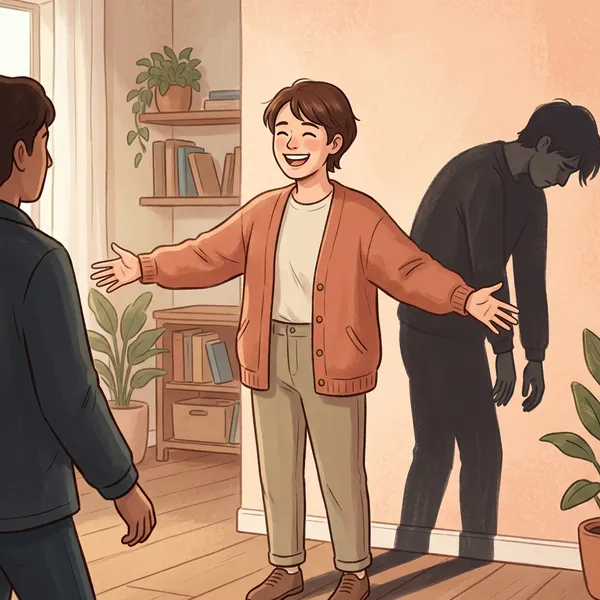
In fawn mode, the nervous system’s social engagement circuitry is recruited not for genuine connection but for appeasement. The person placates, flatters, over-accommodates, and monitors others’ moods with extreme vigilance—not because it feels good, but because the nervous system has learned: “If I keep you calm, I might be safe.” On the surface it often looks like warmth, flexibility, or selflessness. Underneath, it is a form of threat management.
Where Does It Come From?
The fawn response typically develops in early environments where safety, love, or physical wellbeing felt conditional or unpredictable. When a child cannot fight back, cannot leave, and freezing creates disconnection from a needed caregiver, fawning becomes the most viable option: stay close, stay agreeable, and try to manage the other person’s mood before it turns dangerous.
Walker described this as particularly common in children raised with caregivers who were volatile, emotionally dysregulated, or who met emotional needs only when the child behaved in certain ways. Over many repetitions, this strategy becomes automatic and internalised—no longer a conscious choice but a deeply wired default mode activated any time relational threat is perceived, even decades later and in relationships that pose no actual danger. These early adaptations often crystallise into core beliefs such as “my needs are too much” or “I am only safe when others are pleased.”
What Does Fawning Look Like in Adult Relationships?
Because fawning developed as an invisible strategy, it can be genuinely difficult to recognise in oneself. Some common manifestations in adult relationships and workplaces include:
- Saying “yes” automatically, then feeling resentment, exhaustion, or dread afterwards.
- Apologising for things that were not your fault, or when you were not in the wrong.
- Monitoring others’ moods closely and adjusting your own behaviour, tone, or opinions to manage theirs.
- Difficulty identifying your own preferences, needs, or opinions when asked directly.
- Feeling responsible for other people’s emotional states and uncomfortable when they are unhappy—even when their feelings have nothing to do with you.
- Avoiding conflict at all costs, including agreeing with things you disagree with, staying in relationships longer than feels right, or concealing distress to “not be a burden.”
- Feeling safest when others seem pleased, and deeply anxious when they are not.
What Is Happening in the Body?
From a polyvagal perspective, the fawn response occupies an unusual and physiologically costly position. Unlike fight or flight (which are sympathetic nervous system activations oriented toward action) or freeze (dorsal vagal shutdown), fawning appears to recruit both sympathetic arousal and the social engagement system simultaneously—as if pressing the accelerator and the brake at the same time.
Stephen Porges, the neuroscientist who developed polyvagal theory, documented how the ventral vagal system can be co-opted under conditions of relational threat: instead of supporting genuine social connection, it is pressed into service for appeasement. The result is a person who appears socially engaged and calm on the surface but is simultaneously in a state of high internal alertness—scanning, adapting, anticipating. Over time, this sustained activation is associated with significant physiological and emotional cost.
What Is the Psychological Toll of Fawning?
Because fawning is so often met with approval—people who fawn are frequently described as “easy-going,” “selfless,” or “low-maintenance”—the response is socially reinforced, making it even harder to identify and change. Internally, however, the cumulative effects can be severe:
- Identity erosion. When you have spent years orienting yourself around others’ needs and reactions, it can become genuinely difficult to know what you feel, want, or value independently. Many people describe a sense of “not knowing who I am without someone else to help or please.”
- Repressed anger and chronic resentment. Consistently overriding your own needs generates frustration that often has no safe outlet, and can eventually erupt disproportionately or turn inward as depression.
- Emotional exhaustion and burnout. The sustained vigilance required to monitor and manage others’ emotional states is cognitively and physiologically depleting.
- Boundary collapse and codependency. When fawning is the primary relational mode, it becomes very difficult to maintain the sense of where you end and another person begins—an experience closely related to the enmeshment and fusion described in family systems theory. Understanding differentiation can help clarify where healthy closeness ends and self-loss begins.
- Shame and self-abandonment. People who fawn often carry deep internalized shame: not only about their own needs (which feel like impositions or weaknesses) but also about the gap between how they present to others and how they privately feel.
Walker (2013) frames fawning as the trauma survival strategy of “losing oneself in the agenda of the other” to avoid the danger of conflict, abandonment, or attack. From a polyvagal perspective, Porges (2011) describes appeasement-based responses as a way the nervous system attempts to recruit safety through social engagement when fight, flight, or freeze are not available options.
How Is Fawning Different From Genuine Kindness?
This distinction matters and is worth making explicitly, both for clarity and to reduce shame. Genuine kindness and generosity involve choice: they arise from a place of internal security, and the person giving is not simultaneously suppressing fear, monitoring for danger, or sacrificing their basic needs. Fawning, by contrast, is compulsive: it happens automatically and feels difficult or frightening to stop, even when the person wants to.
A helpful self-inquiry question is: “Am I doing this because I want to, or because I am afraid of what happens if I don’t?” When the honest answer is consistently the latter, the behaviour is more likely rooted in threat response than in free choice. This is not a moral failing; it is an adaptation that once made sense and is now ready to be examined.
What Does Recovery Look Like?
Healing from the fawn response is not simply about “setting more boundaries.” For many people, the boundary-setting advice they read or hear creates shame—“I know I should say no, why can’t I just do it?”—without addressing the underlying nervous system pattern that makes it feel unsafe. More sustainable approaches tend to involve:
- Trauma-informed therapy that addresses the origins of the fawn pattern directly, including approaches such as EMDR, somatic therapies, and C-PTSD-informed treatment.
- Somatic and nervous system regulation practices that build a felt sense of safety in the body, so that disagreement or disappointment gradually becomes tolerable rather than threatening.
- Gradual reconnection with internal experience. Practising noticing your own preferences, emotions, and opinions—starting with low-stakes decisions—rebuilds the internal landscape that fawning eroded.
- Tolerating the discomfort of conflict in small doses. Staying present when someone is briefly disappointed without immediately moving to fix, apologise, or appease is a core skill that often needs to be built slowly and in safe relationships.
- Self-compassion. Recognising that the fawn response developed for excellent reasons—it helped you survive—reduces the shame that can otherwise block recovery.
If fawning is severely impacting your relationships, sense of identity, or emotional wellbeing, working with a trauma-informed mental wellbeing professional is strongly recommended.
Key Takeaways
- The fawn response is a trauma survival strategy where safety is sought through appeasing and accommodating others, not through genuine kindness.
- It typically develops in early environments where safety felt conditional on managing a caregiver’s mood.
- In adulthood, it shows up as automatic people pleasing, difficulty saying no, identity erosion, chronic resentment, and boundary collapse.
- The key distinction from genuine kindness is choice: fawning is compulsive and driven by fear of what happens if you stop.
- Recovery involves trauma-informed therapy, nervous system regulation, gradual reconnection with your own needs, and self-compassion for an adaptation that once kept you safe.
References
-
Porges, S. W. (2011). The polyvagal theory: Neurophysiological foundations of emotions, attachment, communication, and self-regulation. W. W. Norton.
-
Walker, P. (2013). Complex PTSD: From surviving to thriving. Azure Coyote.
-
Walker, P. (n.d.). Codependency, trauma and the fawn response. https://www.pete-walker.com/codependencyFawnResponse.htm
-
Walker, P. (n.d.). The 4Fs: A trauma typology in complex PTSD. https://pete-walker.com/fourFs_TraumaTypologyComplexPTSD.htm
-
CPTSD Foundation. (2025, June 5). Fawn response: The trauma survival pattern that’s mistaken for kindness. https://cptsdfoundation.org/2025/06/05/fawn-response-the-trauma-survival-pattern-thats-mistaken-for-kindness/
-
Mahertherapy, M. (2025, April 19). Fawn trauma response: Why you people-please to survive. https://maggiemahertherapy.com/the-fawn-response-why-you-keep-people-pleasing-even-when-it-hurts/
-
Wright, A. (2026, March 15). The fawn response vs. people-pleasing: What’s the difference? https://anniewright.com/fawn-response-vs-people-pleasing/
-
PsychCentral. (2022, January 9). The fawn response: How trauma can lead to people-pleasing. https://psychcentral.com/health/fawn-response
-
Love on the Autism Spectrum. (2025, July 13). Understanding the fawn response in CPTSD: Practical healing. https://www.loveontheautismspectrum.com/fawn-response/
-
Trauma Geek. (2021, September 21). Fawn: The trauma response that is easiest to miss. https://www.traumageek.com/blog/fawn-the-trauma-response-that-is-easiest-to-miss
-
Psychology Today. (2025, April 22). Demystifying the fawn response. https://www.psychologytoday.com/us/blog/bipoc-mental-health/202504/demystifying-the-fawn-response
You might also like