

How Movement Reduces Depression and Anxiety

Physical activity is one of the most consistently supported lifestyle factors for emotional wellbeing. A large meta-analysis pooling data from many cohorts (Pearce et al., 2022) found that even modest movement — about 1–2 hours of brisk walking per week — is associated with a significantly lower risk of developing depression, while a network meta-analysis of 218 randomised trials (Schuch et al., 2024, The BMJ) showed that structured exercise produces reductions in depressive symptoms comparable to many established psychological treatments.
Physical activity is not just “good for your body” — it is one of the most consistently supported lifestyle factors for emotional wellbeing. Large-scale reviews and meta-analyses show that regular movement is associated with a lower risk of developing depression and can reduce symptoms in people who already live with depression and anxiety.
From an emotional wellbeing perspective, movement acts like a multi-channel intervention: it can shift brain chemistry, improve sleep, enhance self-worth and body image, and increase a sense of mastery and control. This combination makes physical activity a powerful adjunct to psychotherapy and, when appropriate, medication — not a replacement, but an accessible tool many people can use, alongside self-compassion and other gut-brain supports such as sleep and a varied diet.
Does Physical Activity Lower the Risk of Developing Depression?
Observational studies following hundreds of thousands of people over time have found a clear association between physical activity and reduced risk of future depression. A large analysis pooling data from multiple cohorts (Pearce et al., 2022) suggests that people who engage in even modest amounts of activity—such as about an hour or two of brisk walking per week—have a significantly lower risk of developing depressive episodes than those who are largely inactive.
Interestingly, the relationship between movement and depression risk is not all-or-nothing. The greatest benefit appears when people move from “almost no activity” to “some regular movement,” with smaller additional gains at higher volumes. This is encouraging: you do not need to become an endurance athlete to experience meaningful benefits for your mood.
Can Exercise Help as an Adjunctive Treatment for Depression?
Beyond prevention, structured exercise has been studied as an intervention for people who already have depressive symptoms. Systematic reviews and network meta-analyses of randomised controlled trials (Schuch et al., 2024; Cooney et al., 2026) consistently find that exercise leads to moderate reductions in depressive symptoms, comparable in size to many established psychological treatments and some pharmacological approaches when used as part of a broader care plan.
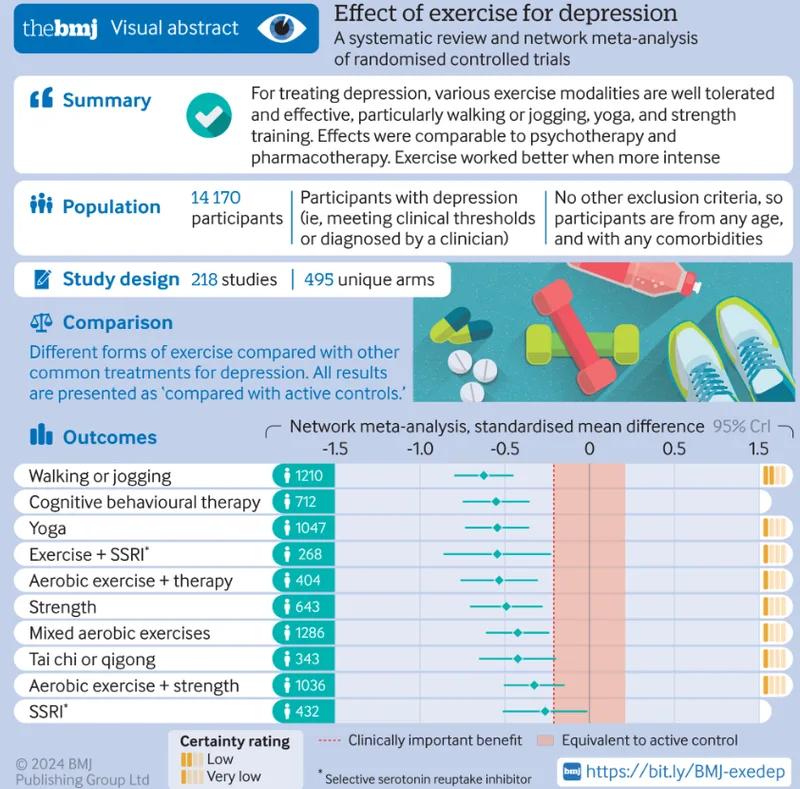
Different forms of movement—such as aerobic exercise (e.g., walking, jogging), resistance training, and mind–body practices like yoga—have all demonstrated benefits. Some analyses suggest that moderate-intensity activity and resistance training may produce particularly robust effects, but the most important factor appears to be regularity and finding a form of movement that is realistic and acceptable for the individual.
What Are the Benefits for Anxiety and Psychological Stress?
Physical activity is also associated with reductions in anxiety and stress (Firth et al., 2025). Reviews of intervention studies indicate that exercise can lead to small-to-moderate improvements in symptoms of generalised anxiety and psychological distress, especially in people with mild to moderate difficulties. These benefits have been observed across different age groups and in both clinical and non-clinical samples.
A particularly interesting body of work looks at the acute effects of a single exercise session. Studies in adults, including those with major depressive disorder (Herring et al., 2023), show that one bout of moderate-intensity aerobic activity can reduce state anxiety and improve mood for at least 30 minutes afterwards, compared with rest. While temporary, these short-term shifts can be harnessed as part of day-to-day coping strategies—for example, using a brief walk or light workout as one tool in managing spikes of anticipatory anxiety.
How Does Movement Support Emotional Wellbeing?
The pathways linking physical activity and emotional wellbeing are complex, and no single mechanism explains all the effects. However, several consistent themes emerge across reviews (White et al., 2024; Oka et al., 2023):
Neurobiological changes
Regular exercise influences neurotransmitter systems (such as serotonin, dopamine, and endorphins) and may enhance neuroplasticity, including increased levels of brain-derived neurotrophic factor, which supports brain function and resilience.
Regulation of physiological stress systems
Physical activity can help regulate the hypothalamic–pituitary–adrenal (HPA) axis and autonomic nervous system, supporting a more flexible stress response rather than chronic hyperarousal or shutdown.
Improvements in sleep
Better sleep quality and duration are frequently observed in people who are more physically active, and sleep, in turn, has a strong bidirectional relationship with mood and anxiety.
Psychological mediators
A recent systematic review (White et al., 2024) identified changes in self-esteem, physical self-worth, body image satisfaction, self-efficacy, and feelings of competence as important mediators between physical activity and emotional wellbeing outcomes. When people experience their bodies as more capable and trustworthy, this often translates into broader psychological resilience and a more stable sense of self-worth.
Social and environmental factors
Many forms of movement involve being outdoors or with others. Exposure to natural environments and social connection can both have independent positive effects on emotional wellbeing, which may combine with the direct effects of exercise itself.
How Much and What Kind of Movement Is Needed?
Public guidelines typically suggest at least 150 minutes per week of moderate-intensity aerobic activity (such as brisk walking) plus muscle-strengthening activities on two or more days. From an emotional wellbeing standpoint, evidence suggests that benefits begin at lower doses: moving from almost no activity to even half of these recommendations is associated with a meaningful reduction in depression risk (Pearce et al., 2022).
When it comes to type of exercise, there is no single “best” option for everyone. Aerobic activities, resistance training, group sports, yoga, and mixed programmes have all shown positive effects on depression and anxiety symptoms. The most sustainable choice is typically one that matches a person’s preferences, physical condition, and environment—and that can be integrated into daily life without becoming another source of stress.
What Are Some Practical and Gentle Starting Points?
While the research is encouraging, it is important to approach physical activity in a way that is compassionate and realistic. Many people struggling with depression or anxiety also experience fatigue, low motivation, pain, or limited access to safe spaces for exercise. In these contexts, it can be helpful to think in terms of “movement” rather than “workouts,” and to focus on small, achievable steps.
Examples include short walks, light stretching, beginner-friendly strength exercises at home, or low-intensity activities done in very small time blocks. For some, tracking progress or receiving tailored prompts—such as through a wellbeing-focused AI companion—can support consistency. If repetitive negative thinking is part of what makes it hard to start, understanding the difference between rumination and reflection may help. Movement should never be framed as a moral obligation or a cure-all, but as one potentially helpful tool alongside therapy, medication, social support, and other evidence-based strategies.
Key Takeaways
- Even modest physical activity—such as 1–2 hours of brisk walking per week—is associated with a significantly lower risk of developing depression.
- Exercise produces moderate reductions in depression symptoms, comparable to psychotherapy and some pharmacological approaches, according to large-scale meta-analyses.
- Benefits extend to anxiety and stress, with even single exercise sessions reducing state anxiety for at least 30 minutes.
- There is no single “best” exercise for emotional wellbeing—walking, resistance training, yoga, and mixed activities all show positive effects.
- The biggest gains come from moving from almost no activity to some regular movement; you do not need intense workouts to benefit.
- Movement supports emotional wellbeing through multiple pathways including neurobiological changes, better sleep, improved self-worth, and social connection.
References
-
Cooney, G. M., et al. (2026). Is exercise effective for treating depression? Cochrane systematic review. Cochrane Database of Systematic Reviews. https://www.cochrane.org/evidence/CD004366_exercise-effective-treating-depression
-
Firth, J., et al. (2025). Systematic umbrella review and meta-meta-analysis: Effectiveness of physical activity for depression and anxiety. Journal of Affective Disorders.
-
Herring, M. P., et al. (2023). Dose-response effects of acute exercise intensity on state anxiety in women with major depressive disorder. Frontiers in Psychiatry, 14, 1090077.
-
Oka, R. K., et al. (2023). Role of physical activity on mental health and well-being: A review. Healthcare, 11(1), 1–15.
-
Pearce, M., et al. (2022). Association between physical activity and risk of depression: A systematic review and meta-analysis. JAMA Psychiatry, 79(6), 550–559.
-
Schuch, F. B., et al. (2024). Effect of exercise for depression: Systematic review and network meta-analysis. The BMJ, 384, e075847.
-
White, R. L., et al. (2024). Physical activity and mental health: A systematic review of mediators and moderators. Sports Medicine.
You might also like