
Imposter Phenomenon: Why Success Feels Fraudulent

Imposter phenomenon is the persistent belief that your success is undeserved and that you will eventually be exposed as a “fraud,” despite clear external evidence of competence. Identified by psychologists Pauline Clance and Suzanne Imes in 1978, it shows up as discounting praise, overpreparing, attributing achievements to luck, and feeling that each new success raises the stakes for being “found out.”
You get the promotion, the praise, the results — and instead of relief, there is a tightening in your chest. A quiet voice that says: they’ll figure out I don’t really belong here. If that sounds familiar, you are not alone, and you are not actually a fraud.
What Is Imposter Phenomenon?
Imposter phenomenon describes the persistent belief that your success is undeserved and that you will eventually be exposed as a “fraud,” despite clear external evidence of competence. People experiencing it often attribute achievements to luck, timing, other people’s mistakes, or simply “fooling” others, rather than to their own abilities or effort.
This is not the same as ordinary humility or occasional doubt. The anxiety can be chronic and intense: promotions, awards, or praise may briefly relieve it, but soon become new sources of pressure—more evidence of how far there is to fall if you are “found out.”
How Does It Show Up in Everyday Life?
Imposter feelings can appear in many subtle ways, for example:
- Discounting praise: mentally correcting compliments with “If only they knew…” or “They’re just being polite.”
- Overpreparing: spending excessive time double-checking or perfecting work to prevent mistakes that might “give you away.”
- Avoiding visibility: turning down opportunities, roles, or speaking invitations because they feel too risky.
- Comparing up: focusing on people you see as more competent and using them as proof that you do not belong.
- Reinterpreting success as threat: each achievement raises the stakes, increasing the fear that the next task will finally expose your “true” incompetence.
Ironically, these patterns can coexist with objectively strong performance. From the outside, others may see confidence and capability; from the inside, it feels like a fragile performance that must be constantly maintained.
Why Can Success Make It Worse, Not Better?
You might expect that more success would reduce imposter feelings, but for many people the opposite happens. Each achievement becomes another piece of “evidence” that others have an inflated view of you. Instead of updating your self-image (“Maybe I am capable”), you may update your fear (“Now there’s even more to lose”).
Two processes often keep the cycle going:
- Attribution bias. Successes are explained away (luck, easy tasks, other people’s help), while difficulties or criticism are taken as proof of deep inadequacy.
- Raising the bar. As soon as you meet one standard, it stops “counting.” You move the goalposts: “Anyone could have done that,” “Real experts would do more,” so your internal sense of competence never catches up with your actual track record.
Over time, this can contribute to chronic anxiety, burnout, and problems with work–life boundaries, because working harder feels like the only available way to manage the fear.
Where Do Imposter Feelings Often Come From?
There is no single cause, but several recurring themes show up in people’s histories:
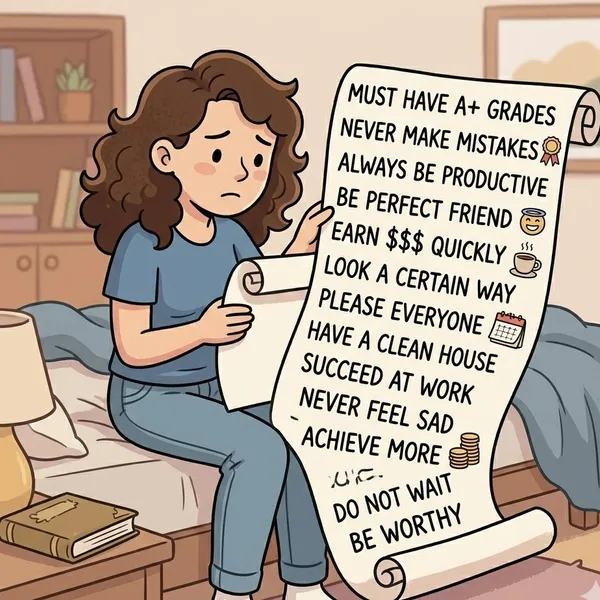
- Early messages about achievement. Growing up in environments where worth felt closely tied to performance, or where criticism was frequent and praise rare, can make success feel precarious rather than secure. These messages often become deeply embedded core beliefs about who you are and what you deserve.
- Being “the only” or “one of few.” People who are underrepresented in a field—for example by gender, ethnicity, class background, or educational pathway—often face extra scrutiny and subtle bias, which can amplify self-doubt even when they are highly qualified.
- Perfectionism and conditional self-worth. If your internal rule is “I’m okay only when I’m flawless,” then normal learning curves and small mistakes can feel like confirmation that you do not belong.
- Role transitions. Starting a new job, entering graduate school, founding a company, becoming a parent, or moving into leadership can temporarily outpace your internal identity, creating a gap between “how others see me” and “how I see myself.”
It is important to emphasise that having imposter feelings does not mean you are an imposter. They are often understandable responses to internal rules and external contexts, not accurate reflections of your abilities.
How Can You Move From “I’m a Fraud” to “I’m a Learner”?
Completely eliminating self-doubt is not realistic—and not necessary. The aim is to change your relationship with these thoughts so they no longer dictate your behaviour. Helpful directions include:
- Naming the pattern. Simply recognising “This is imposter thinking showing up” creates distance; it becomes one possible interpretation, not unquestioned truth.
- Checking the evidence both ways. Instead of searching only for “proof” of incompetence, deliberately include data that contradicts the imposter story: projects you carried, skills you built, times feedback was positive without a hidden agenda.
- Normalising learning curves. Reframing challenges as expected parts of growth (“Of course I don’t know everything yet”) reduces the shame attached to not being instantly expert.
- Sharing selectively with safe people. Talking about imposter feelings with trusted peers, mentors, or therapists often reveals that others you respect experience similar doubts, which can loosen the sense of being uniquely fraudulent.
- Aligning with values rather than fear. Acting based on what matters to you (for example, contributing, learning, helping) rather than on what will least expose you can broaden your behavioural choices, even when imposter thoughts are present. Pairing this with self-compassion can reduce the shame that often accompanies imposter feelings.
When imposter fears tip from “I’m not as competent as people think” into the global conviction “I’m fundamentally bad and people will discover it,” the experience often overlaps with internalized shame, and may need to be addressed at that deeper level too.
In their foundational paper, Clance and Imes (1978) studied 150 high-achieving women and found that, despite objective evidence of competence (advanced degrees, professional recognition, peer respect), the women persistently described themselves as “phony” and attributed their successes to luck, error, or having fooled others. The paper named the phenomenon and described the mechanisms by which success can paradoxically intensify rather than relieve self-doubt.
For some, especially when imposter fears are tied to long-standing perfectionism, trauma, or chronic anxiety or depression, working with a licensed mental wellbeing professional can provide a structured space to explore and renegotiate the underlying beliefs.
Key Takeaways
- Imposter phenomenon is the persistent belief that your success is undeserved and that you will be “found out,” despite clear evidence of competence.
- It is not ordinary humility—the anxiety is chronic, and success often makes it worse by raising the stakes.
- Two key mechanisms keep it going: attributing success to external factors while internalising failure, and constantly moving the goalposts.
- Common origins include early messages tying worth to performance, being underrepresented, perfectionism, and role transitions.
- The goal is not to eliminate self-doubt but to change your relationship with it: name the pattern, check the evidence, normalise learning, and act from values rather than fear.
References
-
Clance, P. R., & Imes, S. A. (1978). The impostor phenomenon in high achieving women: Dynamics and therapeutic intervention. Psychotherapy: Theory, Research & Practice, 15(3), 241–247.
-
Zecchini, J. (2025, October 6). Impostor syndrome: Doubting your own talents. https://www.jessicazecchini.it/en/articles/impostor-syndrome-doubting-your-own-talents/
-
With Insight Education. (n.d.). What is impostor phenomenon (IP)? [PDF]. https://with-insight.squarespace.com/s/Impostor-Phenomenon-Information.pdf
-
Serein. (2025, October 19). A universal experience: Imposter syndrome as a race and class issue. https://serein.inc/blog/people-and-culture/a-universal-experience-imposter-syndrome-as-a-race-and-class-issue/
-
Joy Lab Podcast. (2024, September 17). Imposter syndrome is a myth [Audio podcast episode]. https://www.youtube.com/watch?v=oDZITaYyzHY
-
LinkedIn. (2026, January 25). Imposter syndrome linked to self-critical perfectionism [Post]. https://www.linkedin.com/posts/dr-todd-boudreau-76841a6_more-study-on-the-well-know-imposter-syndrome-activity-7421532465468461056-dl_-/
You might also like