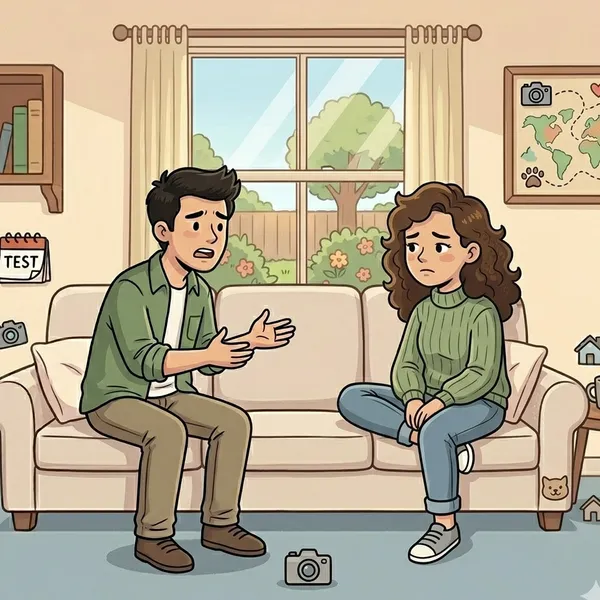

Differentiation: Be Close Without Losing Yourself

Differentiation of self is the ability to stay emotionally connected to the people you love while keeping a clear sense of your own thoughts, feelings, and values. Coined within Bowen family systems theory, it is the middle ground between losing yourself in a relationship (emotional fusion) and pulling away to protect yourself (emotional cut-off) — connected and separate at the same time.
One of the most common tensions in close relationships is the pull between wanting to feel connected and needing to stay yourself. Many people swing between two extremes: merging with the other person’s emotions and losing their own perspective, or pulling away to protect their sense of self. Neither feels quite right — and neither has to be the only option.
What Is Differentiation?
In Bowen family systems theory, differentiation of self is the ability to stay emotionally connected to others while maintaining a clear sense of your own thoughts, feelings, and values. A well-differentiated person can care deeply about people, tolerate their emotions, and stay in dialogue—even when there is tension—without automatically mirroring or rejecting the other person’s reactions.
Low differentiation, by contrast, often shows up as emotional fusion (being overly affected by others, struggling to say no, feeling responsible for their feelings) or as emotional cut-off (creating distance, withdrawing, or shutting down to avoid being swallowed up). Differentiation is about finding the middle ground: connected and separate at the same time.
What Does Closeness Without Fusion Look Like?
In fused relationships, the boundary between “you” and “me” becomes blurry. One person’s mood can dictate the emotional climate for everyone, and disagreements can feel like existential threats rather than differences of perspective. People may over-function (taking charge, fixing, managing) while the other under-functions (relying heavily on the partner to think or decide), or partners may become highly reactive and critical when anxiety rises.
Differentiation allows partners to notice this pull toward fusion without giving up the relationship. A more differentiated person can think even when emotions are strong, hold onto their own position without attacking the other, and stay curious about the other person’s experience instead of trying to control or avoid it. This ongoing curiosity about who the other person is now — not just who they were when you met — is what relationship researchers describe as love maps, and it pairs naturally with differentiated connection. When differentiation is low, couples often fall into a pursuer–distancer dynamic where one partner chases connection while the other withdraws.
Kerr and Bowen (1988) describe a well-differentiated person as someone who can “be in emotional contact with others, yet still autonomous in their own emotional functioning” — neither cut off from the relationship system nor swept along by it.
Why Is Differentiation Not the Same as Emotional Distance?
It can be tempting to confuse “not losing myself” with staying detached or guarded. From a Bowen perspective, emotional cut-off—avoiding contact, keeping conversations superficial, or staying constantly “busy”—is usually a sign of low differentiation rather than maturity. The person is still highly affected by the relationship, but manages that anxiety by pulling away instead of staying present as themselves.
True differentiation shows up when someone is able to stay in contact while holding onto their sense of self. They can say “I see it differently,” “I care about you and I’m not able to do that,” or “I’m feeling overwhelmed and need a pause, but I’m not leaving the relationship.” This capacity to maintain both connection and boundaries is a key marker of emotional maturity in close relationships.
What Are the Signs You Are Becoming More Differentiated?
Differentiation is not a fixed trait; it develops gradually and can change over the life span. Some everyday signs that your differentiation is growing include:
- You can notice your feelings without automatically acting on them, especially in conflict.
- You can listen to someone else’s strong emotion or criticism, take what is useful, and leave the rest, without collapsing or attacking.
- You can express your own needs, limits, and preferences more clearly, even when others might not agree.
- You are less preoccupied with changing or managing others, and more focused on how you want to show up in the relationship.
People with higher levels of differentiation generally report lower chronic anxiety and more stable, satisfying relationships, because they are less driven by reactivity and more guided by considered choices.
How Can You Practise Differentiation in Relationships?
In therapy and in everyday life, working on differentiation often involves small, repeatable steps rather than dramatic confrontations. Examples include:
- Separating thoughts from feelings. Taking a moment in tense interactions to name internally, “I’m feeling anxious and my thought right now is that they’re disappointed,” rather than treating the feeling as a fact.
- Using more “I” statements. Speaking from your own position—“I think,” “I feel,” “I’m choosing”—instead of speaking for the other person or the relationship as a whole. (For more on this and other practical skills, see communication tools for healthier conversations.)
- Staying in contact while disagreeing. Practising saying “I see this differently, but I still care about you,” and tolerating the discomfort that comes with not resolving everything immediately.
- Working on your side of the pattern. Instead of focusing on how the other person should change, paying attention to your own reactivity, over-functioning, or distance, and experimenting with slightly different responses.
These shifts can feel uncomfortable at first, especially in families or partnerships where fusion or cut-off have been the norm for years, but over time they create more room for both people to be fully themselves while staying emotionally connected. In some cases, chronic people-pleasing or loss of identity in relationships is connected to the fawn response — a trauma-related pattern worth understanding if fusion feels deeply automatic.
If difficulties with boundaries, fusion, or emotional distance feel persistent or significantly affect your relationships and wellbeing, it may be helpful to seek support from a licensed mental wellbeing professional in your region for a personalised assessment.
Key Takeaways
- Differentiation of self is the ability to stay emotionally connected while maintaining your own thoughts, feelings, and values.
- Low differentiation shows up as either fusion (losing yourself) or cut-off (withdrawing)—both are driven by anxiety about closeness.
- True differentiation is not emotional distance; it is the capacity to stay present as yourself while remaining in contact.
- It develops gradually through small steps: separating thoughts from feelings, using I-statements, staying in contact during disagreement, and focusing on your own patterns.
- Higher differentiation is associated with lower chronic anxiety and more stable, satisfying relationships.
References
-
Bowen Center for the Study of the Family. (n.d.). Differentiation of self in a family system [Video]. https://www.youtube.com/watch?v=DFW2TO7bboE
-
Kerr, M. E., & Bowen, M. (1988). Family evaluation: An approach based on Bowen theory. W. W. Norton.
-
Living Systems Counselling. (2024, October 30). How are emotional distance and fusion related? https://livingsystems.ca/fusion-and-distance/
-
Neurolaunch. (2025, January 16). Emotional fusion in Bowen theory: Relationships explored. https://neurolaunch.com/emotional-fusion-bowen/
-
Samsel, M. (2020). Fusion and fused relationships. https://michaelsamsel.com/Content/Couples/fusion.html
-
Therapy First. (2025, July 31). The differentiation of self [Video]. https://www.youtube.com/watch?v=UlGmi0AtP-E
-
Welstead, S. (2016). Differentiation in relationships [PDF]. https://suzannewelstead.com/wp-content/uploads/2016/08/Differentiation.pdf
-
My People Patterns. (2023, October 15). Understand your self: Differentiation of self & Bowen [Video]. https://www.youtube.com/watch?v=OnsKYHTppj8
-
Honda, K. (2019, September 25). Bowen family systems therapy: Short explanation [Video]. https://www.youtube.com/watch?v=dSBOpQpkD9o
You might also like