
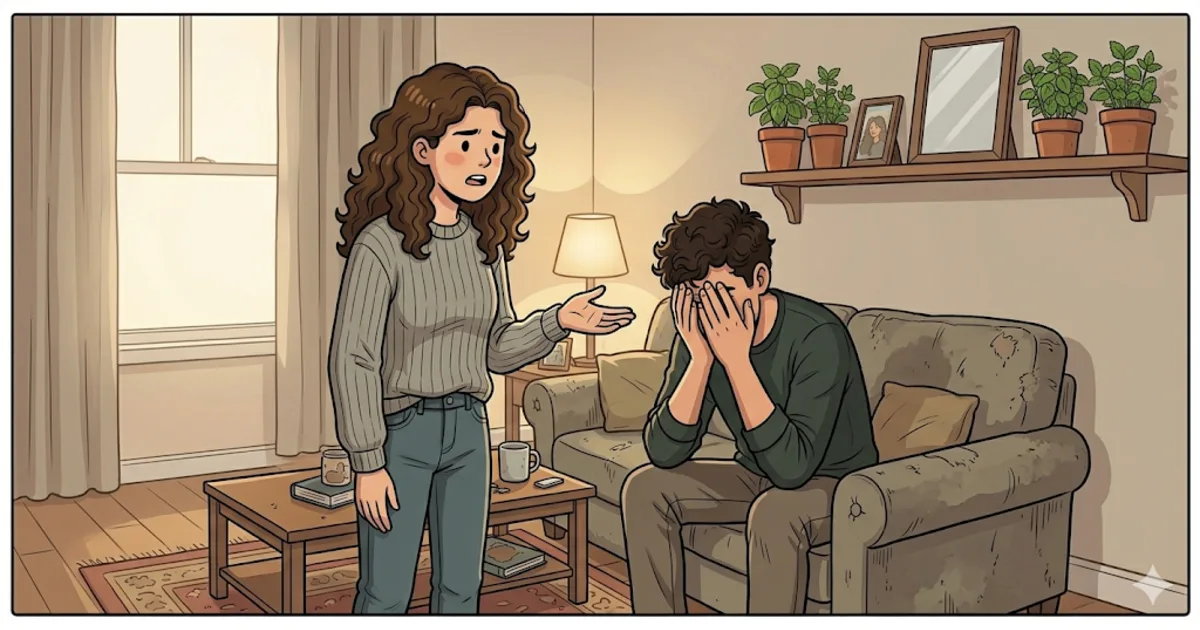
Stonewalling: when shutting down becomes coping

Stonewalling is a pattern in conflict where one partner withdraws from interaction — going silent, shutting down, offering one-word answers, or physically leaving the room. John and Julie Gottman name it as one of the four most damaging dynamics in couple conflict, because it blocks repair (Gottman Institute, 2025). From the inside, it is rarely indifference: it is usually emotional flooding, where the nervous system has become so overwhelmed that disengaging feels like the only available way to cope.
From the outside, though, it lands very differently. The partner being stonewalled often experiences the silence as contempt, punishment, or proof that they do not matter. That gap — between what is happening inside the stonewaller’s body and what the other partner can see — is where most of the damage lives, and also where most of the repair becomes possible.
What does stonewalling actually look like?
Stonewalling can be loud and obvious, or so subtle that both partners only notice it in hindsight. Common signs include:
- Going very quiet mid-conversation, offering only one-word answers, or staring past the other person.
- Repeating phrases like “I don’t know,” “Whatever,” or “I can’t do this” instead of engaging with what has been said.
- Physically leaving the room or suddenly getting busy with tasks — checking the phone, tidying, opening a laptop — to avoid the discussion.
- Changing the subject or joking every time the conversation moves toward something difficult.
- An internal “shut-down” where thoughts go blank, words are hard to find, and the body feels numb, heavy, or far away.
From the stonewaller’s side, it often feels like “if I say anything I will make it worse” or “I am so overwhelmed I cannot think straight.” From the other partner’s side, it usually lands as “you do not care” or “I am talking to a wall.” Both readings are sincere, and both are partial.
It is worth distinguishing stonewalling from a healthy pause. A pause is a stated, time-limited step back so both people can regulate. Stonewalling is an unannounced disappearance — the wall goes up with no explanation and no agreed return.
What is happening inside the nervous system?
Under the surface, stonewalling is usually a physiological event as much as a relational one. Heart rate rises, breathing becomes shallow, muscles tense, and the body shifts into a fight–flight–freeze response — in this case, more often freeze or shut-down than open hostility.
When someone is flooded like this, the prefrontal regions that support reasoning, empathy, and flexible thinking are temporarily less available. They may genuinely struggle to process language, formulate responses, or hold complex ideas in mind. In that state, “just talking it through” right now is less about willingness and more about capacity: the system is trying to survive the moment by minimising input.
Understanding this does not excuse harmful behaviour, but it reframes stonewalling as a maladaptive coping strategy rather than pure malice. That reframe matters, because the two interpretations call for very different responses. A nervous system that is overwhelmed can be helped to regulate; a story that “my partner simply does not care” tends to recruit more pressure, more pursuit, and more shut-down in return.
Many people who stonewall as adults learned the strategy long before they had words for it. If conflict in childhood was unsafe, unpredictable, or routinely went nowhere, going still was often the smartest thing a young nervous system could do. Those early adaptations can harden into core beliefs like “conflict is dangerous” or “I will only make things worse if I speak,” which keep firing long after the original context has changed.
How does stonewalling damage a relationship over time?
Even when it begins as self-protection, stonewalling is corrosive when it becomes the default. Common relational effects include:
- The other partner raises their volume, intensity, or criticism in an attempt to break through the wall.
- A pursuer–distancer dynamic takes hold, where one partner chases connection and the other retreats further and further.
- Both sides build narratives of unfairness: “you never listen” versus “you are never satisfied.”
- Trust erodes. The withdrawing partner begins to dread any serious conversation; the other partner begins to feel fundamentally alone in the relationship.
Research on demand–withdraw — the close cousin of stonewalling, where one partner pushes for discussion and the other retreats — shows just how costly the cycle is. Sanford (2010) studied married couples talking about real disagreements in their own homes and found that demand–withdraw behaviour was reliably linked to lower marital satisfaction, and that the pattern tended to be specific to particular topics rather than a fixed personality trait. In other words: it is the dance, not the dancers, that does the damage — which is hopeful, because dances can be changed.
Over months or years, the pattern hardens into a reflex. Conflict stops feeling like a problem two people are solving together and starts feeling like a trap with two predictable roles: one chasing, one vanishing. The Hart Centre (2025) describes chronic stonewalling as one of the slowest, quietest ways a relationship can become a kind of prison for both partners.
How can the stonewalling partner break the pattern?
Because stonewalling is partly about overwhelm, the most useful interventions work on nervous system capacity and timing, not just on word choice. If you are the partner who tends to shut down, try the following sequence in order:
- Notice the early signals in your body. Tight chest, shallow breath, a sudden urge to leave the room, going blank — these are your cue, not the moment you have already disappeared. The earlier you catch the wave, the more choice you have.
- Name the state out loud, before you withdraw. Something as simple as “I am starting to feel flooded and I cannot think clearly right now” turns an invisible internal event into shared information.
- Ask for a specific pause with a return time. “I need 20 minutes to calm down. I will come back at 8:30 and we can keep talking.” This is the single biggest shift: it converts withdrawal from a threat into a regulated boundary with a clear endpoint.
- Actually regulate during the break. Slow exhales, a short walk, splashing cold water on the face, stretching, putting your hands on something cool — anything that brings your physiology down. Scrolling or rehearsing your defence does not count.
- Come back when you said you would. This is what rebuilds trust over time. Even if you can only say “I am back, I am still a bit raw, but I am here,” the act of returning is the repair.
Practising these steps when nothing is wrong makes them accessible when something is. Couples who only try new tools mid-conflict almost always fall back into the old reflex.
How can the other partner respond without making it worse?
If you are the partner on the outside of the wall, the hardest part is that the moves that feel most natural — pushing harder, raising your voice, following them into the next room — are exactly the moves that deepen the freeze. None of that is your fault; it is your nervous system trying to re-establish connection. It is still worth interrupting.
A few things tend to help:
- Respect the pause when it is asked for. No follow-up texts in the 20 minutes, no continuing the argument through the bathroom door. The pause only works if it is honoured.
- Lower the intensity at the front end. Stonewalling is much more likely to fire in response to criticism or contempt than in response to a specific, concrete request. Tools from a piece on basic communication — soft start-up, one issue at a time, naming feelings rather than character — make the conversation survivable for a flooded partner.
- Share the impact, not an accusation. “When you go quiet, I feel shut out and I start to panic” invites empathy. “You always do this” invites another shut-down.
- Look after your own loneliness. Being on the outside of a wall is genuinely painful. Friendships, movement, sleep, and your own regulation practices are not optional extras while you wait for the relationship to change.
It also helps, in calmer moments, to rebuild the kind of low-stakes knowing that makes flooding less frequent in the first place — the small daily questions and noticing that Gottman calls a couple’s love maps. Couples with a strong base of everyday connection have more goodwill to draw on when a hard conversation lands.
When is it time to work with a professional?
Stonewalling that shows up occasionally, gets named, and gets repaired is part of normal couple life. The signs that outside help would be worth considering include: the pattern has become the default rather than the exception; one or both partners feel chronically alone in the relationship; the shut-down is linked to a trauma history; or every attempt to talk about the pattern itself ends in another shut-down.
Couples approaches such as Emotionally Focused Therapy (EFT) are specifically designed for cycles like this. EFT helps both partners slow the cycle down enough to notice the softer feelings underneath — fear, shame, longing — and to share those feelings in a way the other person can actually receive (FAVA Counseling, 2024). The goal is not to win the argument; it is to make the relationship a place where neither partner has to disappear in order to stay safe.
Key Takeaways
- Stonewalling is usually emotional flooding, not indifference — the nervous system is overwhelmed and shutting down to cope.
- Unannounced withdrawal is what does the damage; a stated pause with a return time is a regulated alternative, not the same behaviour.
- The pattern is reliably linked to lower relationship satisfaction over time, but the cycle can be changed (Sanford, 2010).
- The stonewalling partner’s work is to catch the early signals, name the state, and come back when they said they would.
- The other partner’s work is to lower the intensity at the front end and to honour the pause when it is asked for.
- When stonewalling has become the default, a couples-focused approach such as EFT can help both partners slow the cycle and reach the softer feelings underneath.
References
Empathi. (2026, April 15). Stonewalling in relationships: What’s really happening inside the shut-down. https://empathi.com/blog/stonewalling-in-relationships/
FAVA Counseling. (2024, September 10). How Emotionally Focused Therapy (EFT) can help your relationship. https://favacounseling.com/how-emotionally-focused-therapy-eft-can-help-your-relationship/
Gottman Institute. (2025, May 24). The Four Horsemen: Stonewalling. https://www.gottman.com/blog/the-four-horsemen-stonewalling/
The Hart Centre. (2025, July 23). How chronic stonewalling imprisons a relationship. https://www.thehartcentre.com.au/how-chronic-stonewalling-imprisons-a-relationship/
Sanford, K. (2010). Demand–withdraw patterns in marital conflict in the home. Journal of Family Psychology, 24(5), 605–614.
You might also like